Wisdom To Heal - Pranayama
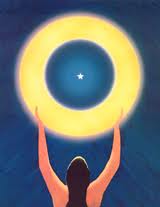
Energy Control
Pranayama then, means energy control. This energy control is often effected with the aid of breathing exercises. Hence, breathing exercises have also come to be known as pranayamas. Patanjali's reference is to the energy control that is achieved as a result of various techniques, and not to the techniques themselves. His word signifies a state in which the energy in the body is harmonized to the point where its flow is reversed no longer outward toward the senses, but inward toward the Divine Self that lies in the hearts of all beings.
Superconsciousness
Only when all the energy in the body can be directed toward this Self can one's awareness be intense enough to penetrate the veils of delusion and enter superconsciousness. The very energy with which we think is the same energy that we use to digest our food. To test this claim, consider how difficult it is, after a heavy meal, to think about weighty problems, and how clear the mind becomes after a fast. To divert all the energy from the body to the brain cannot but intensify one's awareness, and the keenness of one's understanding. To direct this energy inwardly is the first step in divine contemplation.
Prana - Life Force
Prana is the life force which is the underlying, activating power within all creation. The word prana translates as breath, life and energy .Yogananda gave us the example of a car battery: if there is no energy in the battery nothing will make the car move. You can fill it with gas and water, yet nothing will happen without the battery power. It is the same with us; no amount of nutritious food, water, etc, will power the body if prana is not present. The breath acts as a strong stimulus to the flow of life force in the body. These pranayama (prana - life force; yama - control) exercises enable us to, through the medium of the breath, strengthen, control and harmonize the flow of prana in the body.

The Diaphragm
The diaphragm (the dome-shaped muscle/membrane which separates the lungs from the abdominal cavity) works by a downward movement (as you inhale) that causes the lungs to expand, creating a lower air pressure within the lungs than outside the body. In this way air is drawn into the lungs. The downward movement of the diaphragm (as you inhale) expands the abdomen a little outward.
Observe your Inhalation
As you exhale the diaphragm moves back up towards the chest allowing the abdomen to come in towards the spine. In it's resting position, the diaphragm is dome-shaped, with it's top located underneath the heart, and the sides and front attaching to the inner ribcage and the tip of the breastbone. Lying on your back, sitting, or in a standing position, place your palms on your abdomen, and observe your inhalation coming in through your nostrils and drawing the breath into the lower lungs.
Calms the Mind
Visualize/feel the diaphragm descending as you inhale. Feel your abdomen pushing out gently into your hands. Exhale and observe the diaphragm moving upwards towards the chest and your abdomen moving back in. Remove your hands and breathe this way for a few minutes. Ideal for using with the yoga postures. Benefits: An excellent way to release mental / physical stress & tension. It calms the mind and induces a state of relaxation in our body. It gives an internal massage to our abdominal organs, improving digestion and relaxing blocked energy.
FULL YOGIC BREATH

Full Yogic Breath
The diaphragmatic breath is the first stage of the Full Yogic Breath. The second part is the expansion of the ribcage. As the inhalation flows upward from the diaphragm the ribcage expands outward to the sides and a little in back. The third phase is the expansion of the lungs in the chest area. All three phases should flow together smoothly. Exhale slowly in reverse order. You may hold the breath for a few seconds before exhaling. Never strain as you do this breath; the entire inhalation from the diaphragm, into the ribcage area, and into the upper lungs should be one smooth, flowing motion. Maximizes the intake of oxygen and the expelling of carbon dioxide. Relaxes muscular restriction in and around the diaphragm, ribs, and chest, allowing for them breath to flow freely and naturally at all times. It is very energizing for the body; excellent for fasting. Used with visualization, it's great for drawing vitality into every body cell (as you inhale) and expelling all fatigue (exhaling). MEASURED BREATHING sitting position, inhale to the count of 8, hold me breath for 8, and exhale for 8. Adjust the count so there is no straining involved.
Double Breath

Begins with a two-part inhalation, inhale through your nose with a short, sharp inhalation, followed by a long, strong inhalation-completely filling the lungs. Then without pause, exhale through your mouth, again with a short, then a long exhalation-making a breathy sound: Huh, Huhhhhhh," emptying the lungs completely. This breath is a part of Yogananda's Energization Exercises. Powerfully energizes the body and brings clarity to the mind. May be used with tensing the body as you inhale (in a smooth flow, from low tension to high), and relaxing the body as you exhale (in a flow, from tension to complete relaxation). A great tool for releasing all residual tension in body and mind.
Alternate Breathing

Begin by sitting in a meditation asana and take a few deep Full Yogic Breaths. Center yourself in your spine. Using the right hand, bring the index and middle finger into the palm. Extend the thumb and ring and little fingers. The thumb will be next to the right nostril and the ring and little finger at the left nostril. Close the right nostril with the thumb and inhale through the left to a count of 8; close off the left nostril and hold the breath to a count of 8; lift the thumb off the right nostril and exhale (through the right) to a count of 8. Repeat six times. If 8 is too long of a count (or too short), use whatever count works for you. Do not strain. You can slowly increase the count as you are able to.
Pan and Apan
Helps to balance and harmonize the two currents in the spine (the pran and apan). This results in a state of mental poise and in a deepening inner awareness. An excellent preparation to meditation. Can be used with visualization to draw in positive qualities as you inhale; holding the breath fill your consciousness with these qualities; exhaling throw out all opposing states of negativity. Or, as you exhale, surrender yourself into the arms of Infinite Peace.
Cosmic Breath
After Practicing the Breathing Exercises go into inner stillness. Feel the connection between your breath and the Cosmic Breath, as if your breath were but a function of the breezes of cosmic consciousness. In your breathing, as in your working, feel that you are an instrument of the Divine. "
©2014 Wisdom To Heal, 14618 Tyler Foote Road, Nevada City, CA 95959