






Wisdom To Heal - Meditation
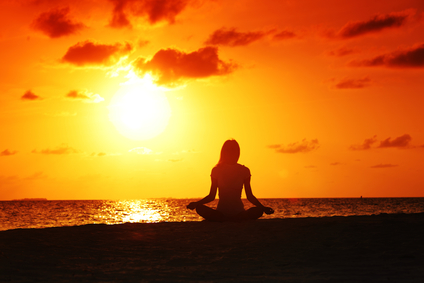
The breath and mind react intimately upon one another. The breath instantly responds to different mental and emotional states. As the breath flows, so flows the mind. By concentrating on the breath, the mind becomes calmer. This is the Hong-Sau technique of concentration and meditation as taught by Paramhansa Yogananda and also by his disciple, Swami Kriyananda, the founder and spiritual director of Ananda.
The Hong-Sau Technique:
1) Energization, prayer, and chanting
are suggested before meditation, but
Hong-Sau actually may be done at any
time and in any place.
2) Inhale and tense the whole body.
Exhale and relax. Repeat three times.
Then, inhale slowly to a count of 6 to
10; hold the breath to that same count;
exhale to that count and immediately
inhale again to the same count. Repeat
6-10 times. Please remember that these
are preliminary breathing exercises, not
the technique itself.
3) Now, without counting or tension,
take a long slow deep breath. When the
breath begins to flow again, begin to
observe its movement, without any
attempt to control it. Notice the place
at which you can observe the breath in
your body whether in the lungs, in the
nostrils, or sinuses. Be an impartial
observer, not caring whether it flows in
or out or remains stationary. Simply
remain attentive to whatever the breath
does by itself, naturally. Moving the
forefinger of the right hand in for
inhalation and out for exhalation may be
helpful for helping you tune into the
breath.
4) Follow the inhalation with the mantra
Hong (pronounced to rhyme with song) and
the exhalation with the mantra Sau
(pronounced like saw). Repeat the mantra
mentally only. Be careful not to move
the lips or tongue. Hong-Sau is a
Sanskrit mantra meaning I am He or I am
Spirit.
5) As your practice deepens, begin to
enjoy the pauses between the inhalations
and the exhalations, when the breath is
not flowing. Do not actively hold the
breath in or out. As many times as your
mind wanders away from Hong-Sau, bring
it gently back to the technique.
6) After your period of practice of this
technique (5-10 minutes is fine for
beginners, gradually increasing the time
as you go) inhale and exhale 3 times,
and then leave the breath out as long as
is comfortable. Then begin breathing
normally.
7) Throughout the practice, keep your
eyes closed and looking upward towards
the point between the eyebrows; don't
strain your eyes; let them relax!
8) After completing your practice of
Hong-Sau, be sure to sit in silence and
stillness for at least as long as you practiced the technique. Practice
devotion, inward chanting, visualization, or prayer.
Practical Hints for Meditation
Meditate at Dawn, Twilight, High Noon, and Midnight.
Regularity, Set aside the same time or
times each day for your meditation.
Recommended are dawn (just after
awakening), twilight, high noon, and
midnight. Another is in the evening,
just before bedtime. Best always to
meditate on an empty stomach (2-3 hours
after meals).
Exercise, If you have time, exercise a
little before meditation. Yoga postures
are excellent and of course, Yogananda's
Energization Exercises are highly
recommended. Remember the exercises one
does before meditation, should calm, not
excite the nervous system.
Set Aside a Small Room
Location, Set aside a room, or small part of a room, just for meditation. Try to find as quiet a spot as possible--or if this is difficult, try using comfortable foam, earplugs or headphones to block out noise. Be sure the room is not stuffy and a bit on the cool side; a blanket or shawl to wrap up in is nice. Have a place to sit, and a small, simple altar or focal point, like pictures, flowers, candles. You will find that the vibrations of meditation build here. Face East, if possible. Yogis say that there are certain natural currents, flowing east to west, which help you meditate better. North is also a good direction.
< Sitting Positions For Meditation
Sitting, Protect yourself from the downward pull of earth currents by sitting on some natural fiber, like a wool or silk blanket or piece of cloth placed on your meditation chair, bench, or cushion. Sit erect! A chair is fine, or a comfortable cross-legged position on the floor or on cushion(s). If you sit in a chair, try not to lean back. Meditation benches are helpful, too. Whatever your position, keep your back straight, chest raised, head erect, eyes closed, and hands resting palms upturned, in your lap, preferably at the juncture of the thighs and abdomen.
Length of Meditation
How long? Do not set unrealistic goals
for yourself. Better to meditate 5-15
minutes and be very consistent about it,
then increase your time as you can. One
longer meditation each week is very
helpful. Also it helps to meditate with
other people, especially devotees who
have been meditating longer than you
have the energy of a group meditation
often helps. you to meditate longer than
you would ordinarily be able to, on your
own.
Upon beginning your meditation, say a
prayer either out loud, or inwardly, to
God and the Masters, to guide and help
you. Do some chanting, if you can (using
a cassette tape of chants is very nice,
sing along with it!). Practice breathing
to relax. Inhale, tense the whole body,
then throw the breath out and relax, do
this 2-3 times. I?
Measured Breathing
Then do some measured breathing: inhale to a count, hold that same count, then exhale to the same count, and begin again, this 6-12 times. The count can be 8-8-8, 12-12-12, or higher if you feel comfortable. Then relax and breathe normally, but be aware of your breathing. You should now feel relatively relaxed. Hold the body still! Mentally check it from time to time to see that no part becomes tensed again inadvertently. Physical tension is a great deterrent to calm meditations. Be very silent and relaxed, yet aware.
©2014 Wisdom To Heal, 14618 Tyler Foote Road, Nevada City, CA 95959